Stop explaining the same server twice.
DevLand keeps a memory of your work on your own machine: where things run, how to reach them, how to deploy, who owns what and why you chose something. Every Claude session can look there before it guesses.
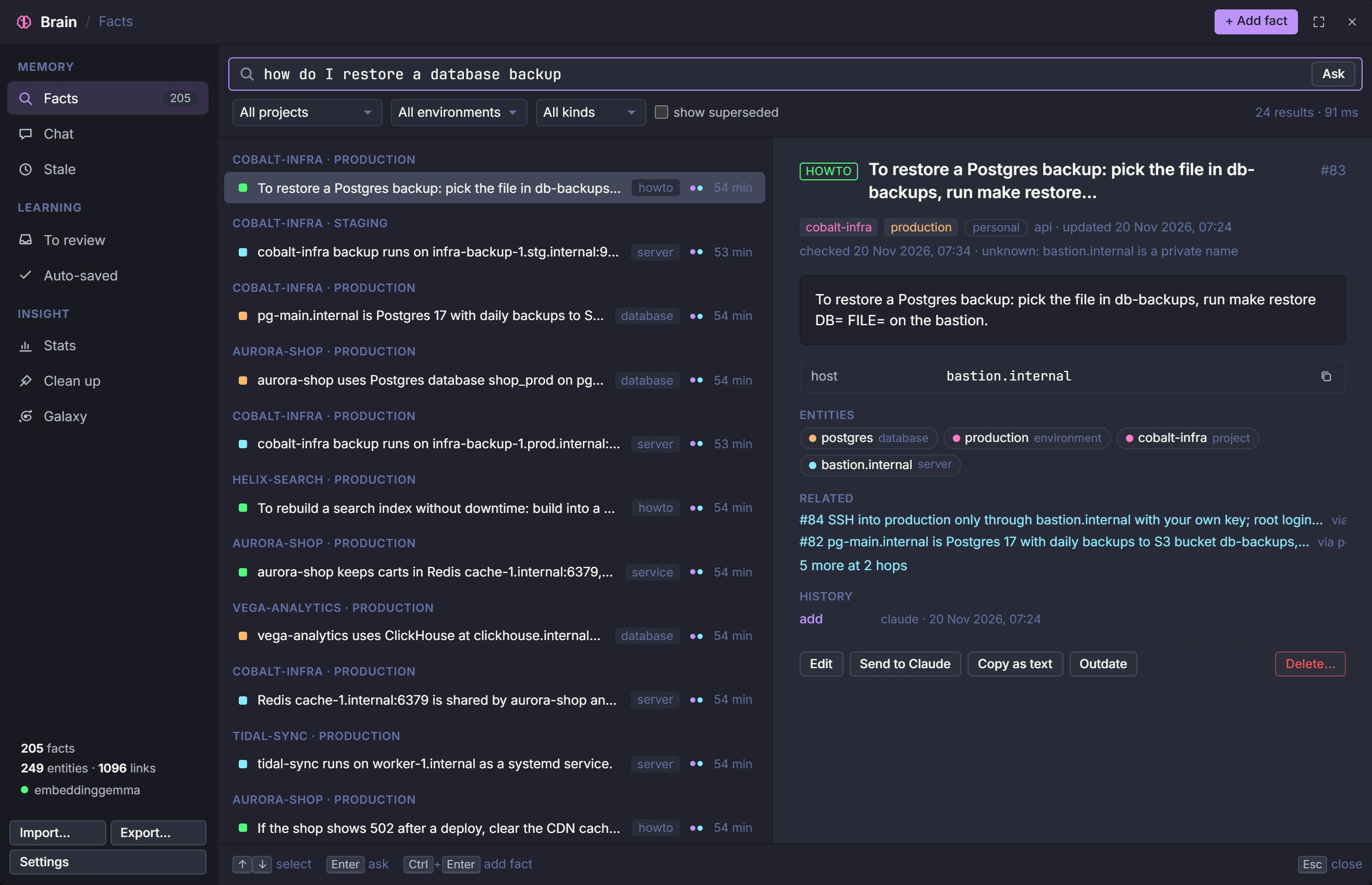
The Brain window in DevLand. A question in plain words finds the right how-to, with the server it needs and related facts.
See how everything you know connects
The same facts as a 3D map. Each project is a galaxy. Each server, service, database, path and person is a star. Try it: drag to turn, click a star to read its facts.
The real Brain Galaxy from DevLand, running in your browser with demo facts. Click inside first to zoom with the wheel. Try searching for facts, for example "how sync works".
Claude asks the Brain first
DevLand gives Claude Code one short rule: before you answer a question about servers, ports, paths or deploys, search the Brain. The search runs on your machine and takes a few milliseconds.
- Works in every Claude tab, new or old
- Finds facts by meaning, not only by exact words
- Looks in the project you are in, plus facts shared by all projects
A memory that keeps itself tidy
Learns from sessions
When a Claude session ends, DevLand reads it and keeps only facts you will still need a month later. Progress notes and to-dos are thrown away.
You stay in charge
Clear facts are saved right away, with an Undo button. Unsure ones wait in an inbox for you. You can edit, merge or delete anything.
Ask it in plain words
Brain chat answers only from your saved facts, and shows which ones it used. No guessing.
Secrets stay locked
Passwords and keys are encrypted on disk. Add a pass lock, and the Brain locks itself when you step away.
Spots stale facts
Once a day, DevLand marks facts whose paths, servers or versions no longer match. So old answers don't fool Claude.
Share with your team
Pick projects to share with your team through CBrain. Your rules decide what may leave your machine.
Clean-up in one click
DevLand finds facts that repeat, facts that disagree and facts nobody uses. Merge or remove them in one click.
Project memory
One tab shows a project's CLAUDE.md rules, its decisions and its changelog, so you see what Claude knows about it.
Your memory, your rules
The Brain lives in DevLand's database on your own disk. Secrets get extra care. DevLand finds them, hides them and locks them away before anything else can use them.
billing_prod on pg-billing.internal:5432, user billing_app, password Tr0ub4dor&3x!
billing_prod on pg-billing.internal:5432, user billing_app, password ••••••••
password [locked, ask the user to unlock DevLand]
Masked by default
DevLand spots passwords, API keys and tokens when a fact is saved. Search, the graph and everything sent to Claude only see a copy with the secret hidden.
Sealed on disk
The real value is encrypted with AES-256-GCM. The key is protected by your pass lock, or by your system login when you have none. Never plain text.
Pass lock and idle lock
Lock the Brain with a pass phrase and a recovery key. It locks itself after the number of idle minutes you choose. While it is locked, Claude only gets "locked, ask the user".
Secret guard
Before a commit or push, DevLand checks the new lines against your saved secrets. So a password from the Brain never ends up in git.
You decide what is kept
The Brain can save only the clear facts by itself, or send everything to your inbox first. You can edit, mark as outdated or delete any fact.
Nothing leaves by itself
Without CBrain, the Brain never talks to a server. With CBrain, each project stays off until you turn it on and see a preview of what would be shared.
Give your Claude sessions a memory
The Brain runs on your machine. It uses a small AI model on your PC to search by meaning, and it works without one too.
Request early access